

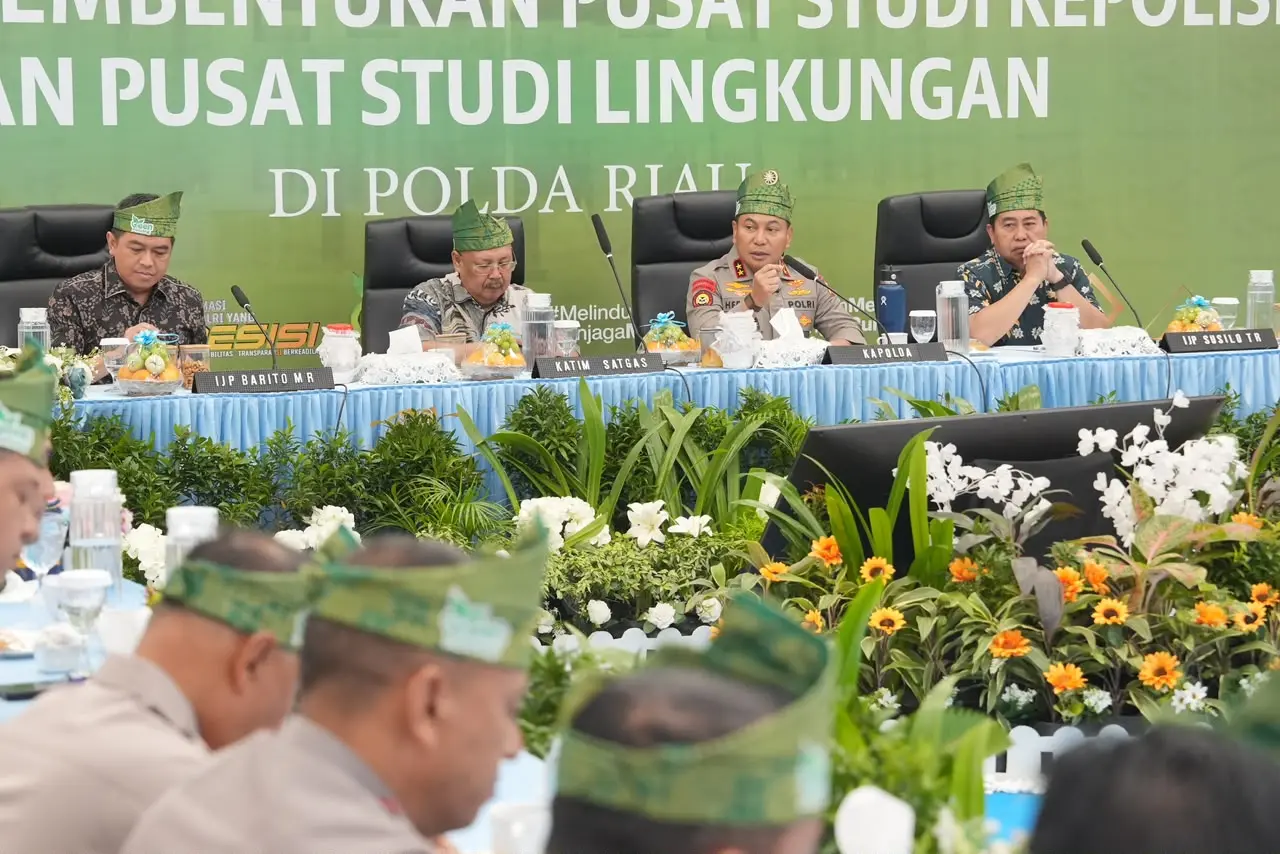
inp.polri.go.id - Jakarta. The Head of the Indonesian National Police (INP) Public Relations Division, Inspector General Johnny Eddizon Isir, stated that the establishment of the Center for Police and Environmental Studies at the Riau Regional Police marks a new milestone in the development of Indonesian police science.
For the first time, the Green Policing concept is being developed through an academic framework that connects INP's operational experience with scientific research and interdisciplinary collaboration.
"Today marks a crucial moment for the transformation of INP. Green Policing is no longer merely an approach to carrying out police duties, but is being developed as a scientific discipline through the Center for Police and Environmental Studies. This is a strategic step to address future security challenges increasingly influenced by climate change, environmental crime, ecological disasters, and the demands of sustainable development," said Johnny.
According to him, the establishment of the study center is part of the development of the INP science ecosystem, which continues to be expanded through partnerships with universities.
"Nationally, we, together with state and private universities, have developed a network of 79 Police Study Centers, consisting of 40 operational centers, 5 centers in the process of signing cooperation agreements, and 34 centers in the process of drafting cooperation agreements. In addition, PTIK has also developed 16 thematic study centers that serve as centers of excellence for the development of various police disciplines. The presence of the Police and Environmental Study Center in Riau enriches this ecosystem by presenting Green Policing studies as a national reference in realizing environmental security," Johnny said.
On the other hand, Herry explained that Green Policing is a policing paradigm that places environmental protection as an integral part of efforts to maintain public security and order.
According to him, environmental damage, forest and land fires, illegal logging, forest encroachment, environmental pollution, and the impacts of climate change are no longer merely ecological issues, but also have the potential to trigger social conflict, economic disruption, humanitarian disasters, and threats to national security.
Herry emphasized that the implementation of Green Policing is built on three main pillars: prevention, law enforcement, and restoration. Prevention is carried out through education, environmental literacy, and community empowerment. Law enforcement is directed at various forms of environmental crimes in a professional and equitable manner, while restoration is achieved through cross-sector collaboration to restore damaged areas.
(ad/ta/pr/rs)