

inp.polri.go.id - Jakarta. Vice Minister of Home Affairs Bima Arya Sugiarto stated that controlling inflation is a crucial factor in driving national economic growth as it impacts increased consumption, production, job creation, and ultimately achieving the eight percent economic growth target.
"If we successfully manage inflation, the spillover effects will be numerous. It will encourage consumption, stimulate production, create jobs, and align with the President's target of 8 percent economic growth," Bima said in a statement in Jakarta on Tuesday (7/28/2026).
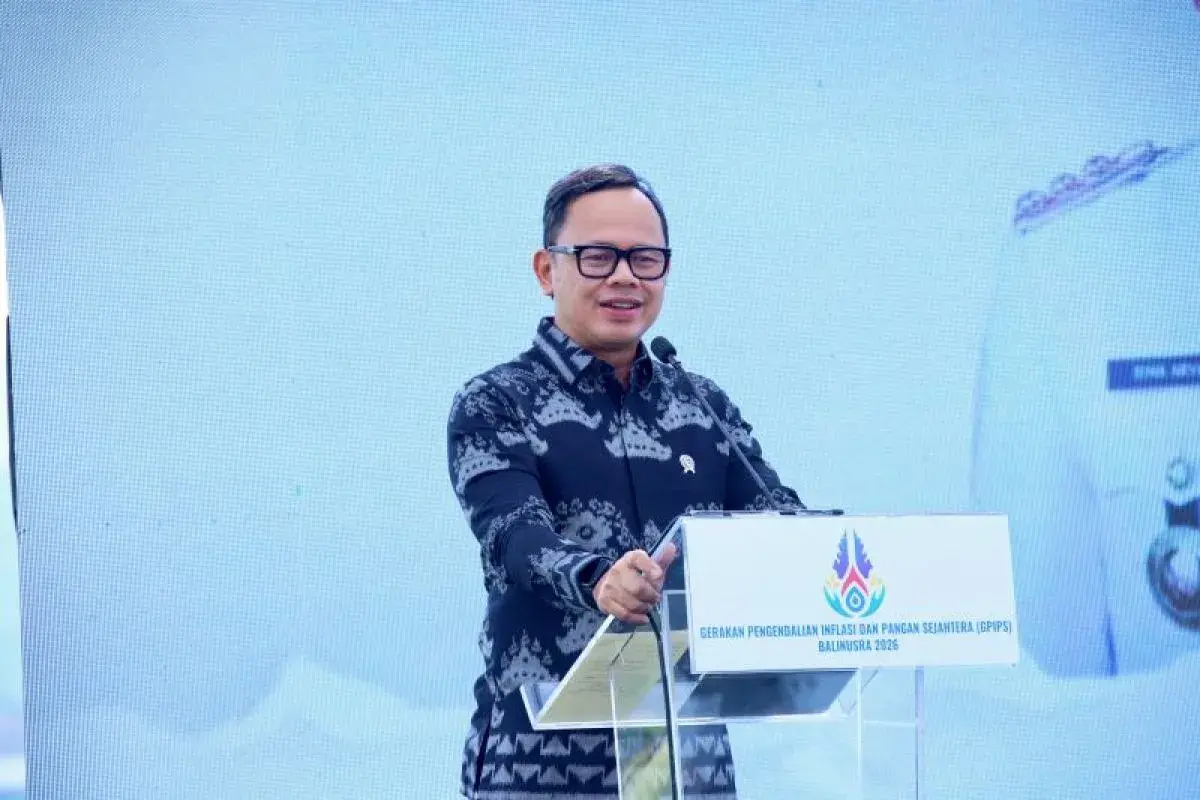
Bima made this statement while delivering a speech at the 2026 Bali-Nusra Regional Inflation Control and Food Prosperity Movement (GPIPS) at Subak Jatiluwih, Tabanan Regency, Bali, on Monday (7/27/2026).
Bima also encouraged regional governments to strengthen synergy in efforts to control inflation and food security.
He explained that the Ministry of Home Affairs consistently monitors inflation control through the Inflation Control Coordination Meeting, which has been running since October 2022.
According to him, this step reflects the government's commitment to maintaining price stability as one of the foundations of national economic growth.
Bima explained that although the goal of controlling inflation is the same throughout Indonesia, the challenges faced by each region vary. Specifically in Bali, West Nusa Tenggara (NTB), and East Nusa Tenggara (NTT), the geographical characteristics of the archipelago make inter-island connectivity and logistics costs crucial factors in maintaining smooth food distribution.
He further explained that high tourism activity, demand during religious holidays, and weather conditions also influence inflation dynamics in these regions.
"The potential is huge, but the problem lies in inter-island connectivity. Logistics costs have a significant impact here. Distribution is just as important, just as crucial as production. Here, production and distribution are equally challenging," he said.
To address these challenges, Bima outlined three main agendas that regional heads need to focus on to strengthen food security. First, strengthening interregional cooperation to ensure smooth food distribution and supply.
Second, optimizing the use of information technology to monitor price developments and market conditions in real time. Third, coordinating policies to protect Sustainable Food Agricultural Land (LP2B) in regional spatial plans as a step to maintain long-term food security.
"So, what we've conveyed illustrates how controlling inflation involves all aspects from upstream to downstream. It involves everyone, not just regional heads. It requires assistance from Bank Indonesia, intervention from Bulog, and strengthening governance from the Ministry of Trade. And of course, the leadership of regional heads is crucial in this regard," he said.
(ad/inp/pr/rs)