

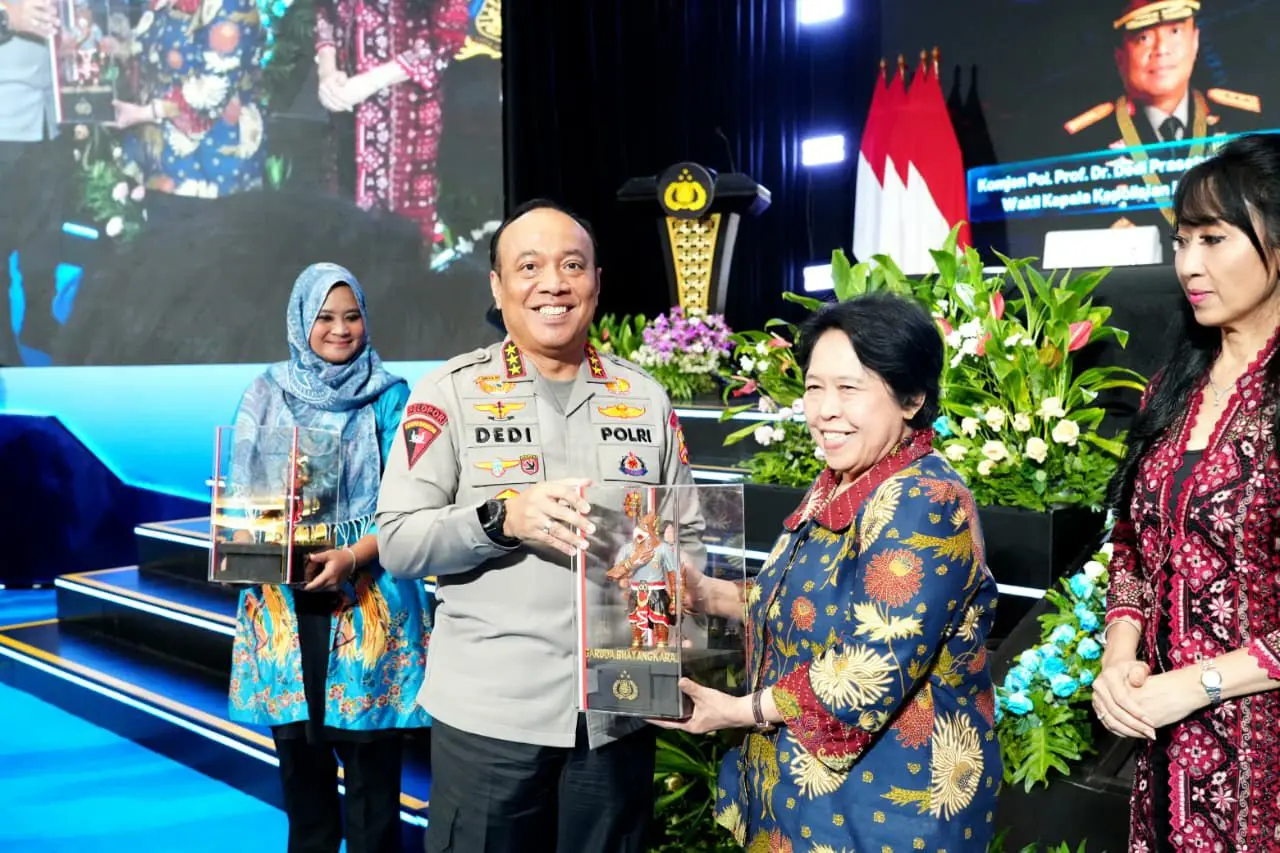
inp.polri.go.id - Jakarta. The Vice Chief of the Indonesian National Police (INP), Commissioner General Dedi Prasetyo, emphasized that the current threat of terrorism and extremism has undergone a fundamental shift, moving from a structured pattern to a more fluid, adaptive digital network that is difficult to detect with conventional approaches.
In his directive, Dedi emphasized that all counterterrorism strategies must be based on the 2025–2045 INP Grand Strategy and aligned with the 2025–2029 INP Strategic Plan, to ensure the effectiveness and sustainability of policies in facing future challenges.
"We are now facing major changes. Threats no longer exist in the form of large, easily mapped organizations, but are evolving through digital spaces, loose sympathizers, and networks formed by algorithms. With these new challenges, we have to adapt," said Dedi.
According to him, modern extremism is now becoming more fragmented, operating through individuals or small groups without formal structures, but consolidated through digital exposure and social environments.
He explained that the perpetrators' ideology no longer exists as a single, unified doctrine, but rather as fragments of ideologies that blend according to the individual's psychological and social needs. Therefore, traditional approaches to understanding extremism need to be complemented by new perspectives, such as Composite Violent Extremism (CoVE), to interpret ambiguous and convergent threats.
Furthermore, Dedi reminded that extremism is now "glocal," where global information flows can rapidly influence local social dynamics through digital media.
"Threats can no longer be understood separately between global and local dimensions. Information flows move rapidly and can influence the social environment in a short time," he emphasized.
Dedi continued that one of the main concerns is the increasing vulnerability of the younger generation to exposure to extremism and the normalization of violence in the digital space.
Data from the INP's Special Detachment (Densus) 88 Anti-terror (AT) as of May 19, 2026, recorded 115 children as members of the True Crime Community (TCC) and 132 children exposed to radicalism in various regions of Indonesia. According to him, these figures must be understood as the tip of the iceberg, so prevention efforts need to be implemented early before they develop into a greater threat.
"Counter-extremism policies that affect children must be built on the logic of early protection, not the logic of early action," said Dedi.
He emphasized that children need to be understood simultaneously as victims and actors, so the approach used must be rehabilitative, protective, and protection-based, not merely punitive.
To this end, Densus 88 AT Polri is directed to use a multi-layered ecological approach (socioecological model), which integrates families, schools, communities, government, and digital spaces as a shared protection system.
This concept is realized through the development of a "Safe Homes to Safe Schools" ecosystem, where the authority acts as a liaison for cross-stakeholder coordination in detecting and preventing potential risks early on.
Furthermore, Dedi also emphasized that the current threat of extremism cannot be addressed by any single institution alone. A collaborative approach is needed, namely active and ongoing collaboration between security forces, ministries and institutions, local governments, schools, families, religious leaders, communities, academics, digital platforms, and civil society.
(ad/ta/pr/rs)