
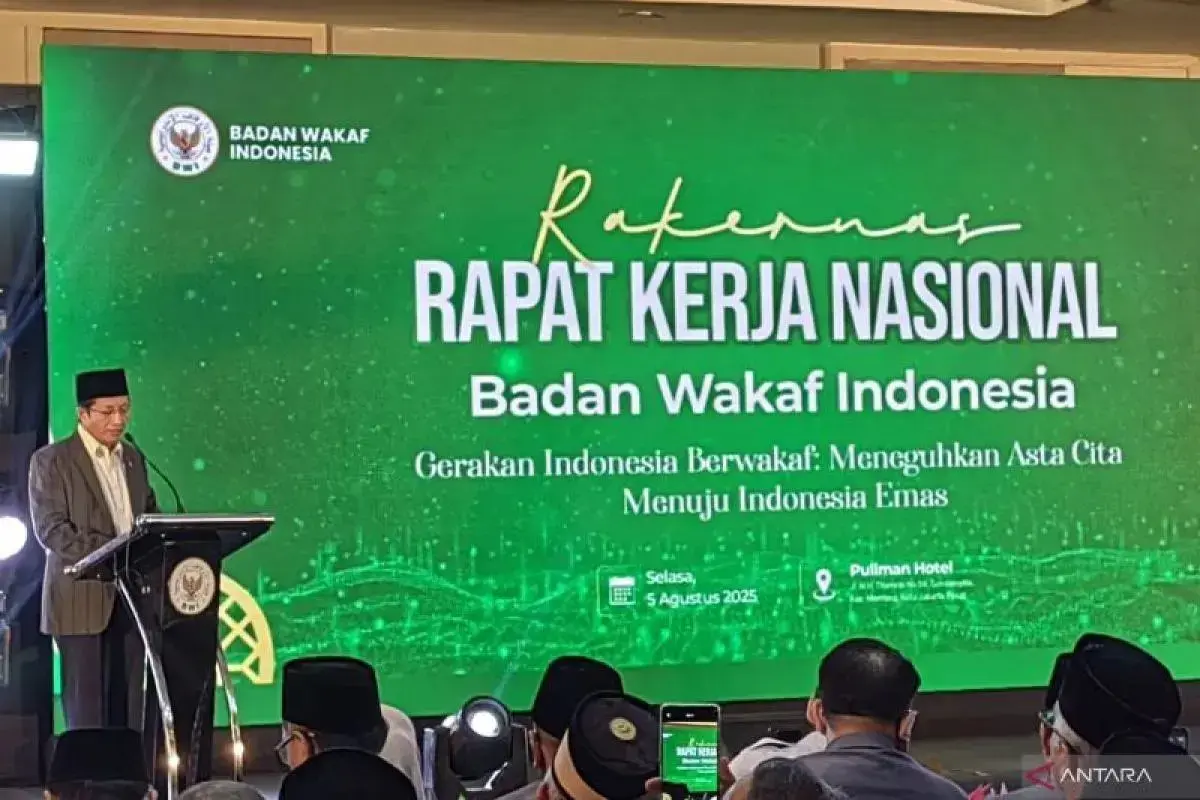
inp.polri.go.id - Jakarta. Minister of Religious Affairs Nasaruddin Umar believes that the potential for cash waqf in Indonesia is enormous and can become an economic strength for the Muslim community if managed professionally.
"We must empower religious institutions to bridge the gap in economic inequality that persists, because the majority of our Muslim community still faces economic hardship," said the Minister of Religious Affairs on Tuesday (8/5/2025).
Minister Nasaruddin stated that waqf is an economic pillar that has the potential to contribute to the welfare of the Muslim community. Cash waqf is an important part of the program to strengthen the Islamic economy and finance.
He hopes that the Indonesian Waqf Board (BWI) can become a driving force for the revival of the modern Islamic economy and civilization through professional and visionary waqf management.
In fact, Nasaruddin stated that Indonesia has a great opportunity to become the center of global Islamic civilization, replacing the dominance of the Middle East if religious funds can be properly utilized.
"Now is the time for Indonesia to take on that role. Strong waqf and religious institutions will be key," he said.
Meanwhile, the Head of BWI, Kamaruddin Amin, stated that based on a study conducted in collaboration with Baznas (National Zakat Agency) and several other authoritative institutions, the potential for cash waqf in Indonesia is estimated to reach IDR 181 trillion per year.
However, to date, only IDR 3.5 trillion has been collected in cash waqf funds.
"This means the gap between potential and realization is still very large. This presents both a challenge and an opportunity for us to capitalize on this extraordinary potential," said the Head of BWI.
To that end, BWI and the Ministry of Religious Affairs are preparing an ecosystem and regulations to ensure that cash waqf can be implemented massively, transparently, and responsibly.
(ad/ndt/pr/rs)