

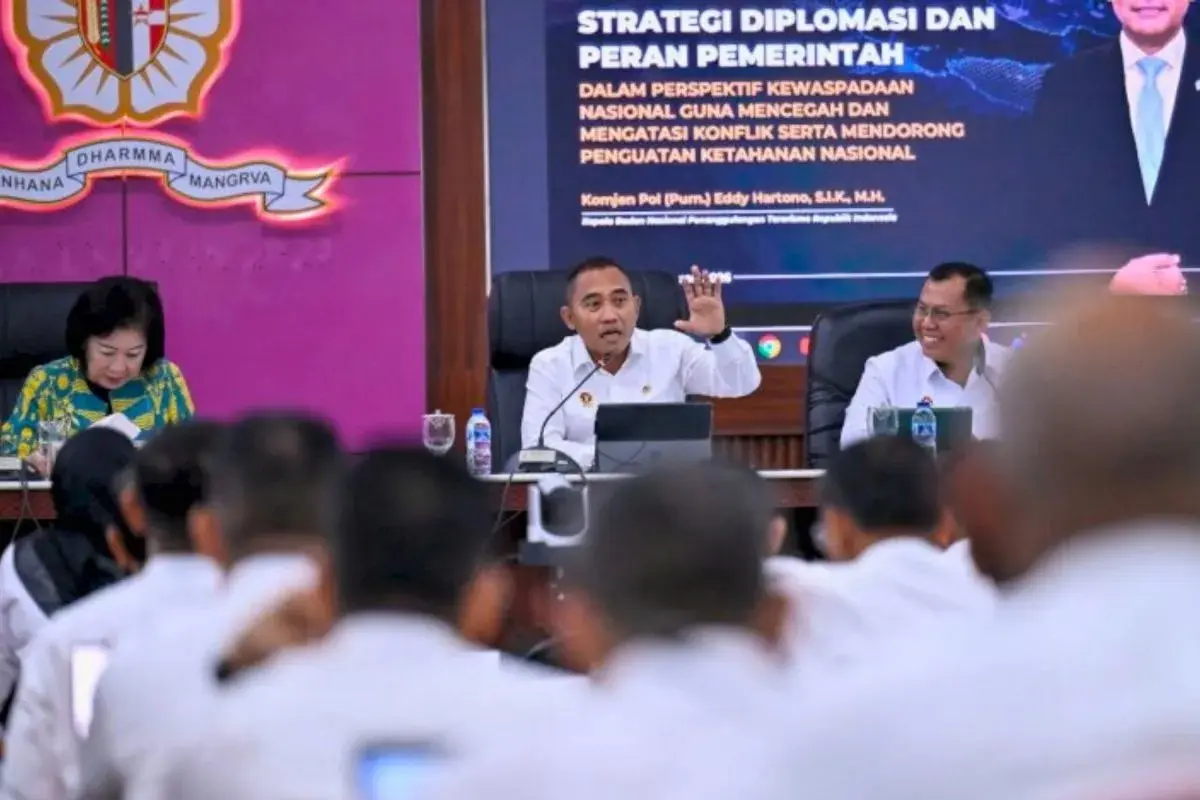
inp.polri.go.id - Jakarta. The National Counterterrorism Agency (BNPT) emphasized that terrorism remains a persistent and adaptive global threat in the digital space.
BNPT Head, Eddy Hartono, stated that terrorism is a serious concern for the international community due to its constantly evolving nature and adapting to the dynamics of the times.
"The United Nations (UN) assesses that terrorism remains a global threat," he said on Thursday (2/19/2026).
He explained that the UN uses the language of "persistent and adaptive," meaning that terrorist networks remain a latent danger, a continuous threat, and adapt to current developments, thus adapting their strategic movements accordingly.
Therefore, the BNPT Head said, while previously the strategy used physical means by utilizing various information media, such as leaflets and magazines to convey propaganda, incitement, and so on, they have now shifted to the digital space.
Eddy stated that there has been a transformation in the movements of global terrorist groups, where they have become decentralized from previously centralized and hierarchical commands, to moving in the digital space from previously territorial control, and to becoming lone wolf or independent cells from initially organized ones.
He further emphasized that Indonesia has developed four strategic pillars in responding to the dynamics of these threats, referring to the global strategy established by the United Nations.
The four UN Global Counter-Terrorism Strategies include addressing the conditions that encourage the spread of terrorism, preventing and combating terrorism, building state capacity and strengthening the role of the UN, and ensuring respect for human rights and the rule of law.
He added that the counter-terrorism approach is not only through law enforcement, but also prioritizes prevention through strengthened dialogue and in-depth studies of the root causes.
(ad/ndt/pr/rs)